
German research on the Galileo family focuses entirely on its most prominent representative: the natural scientist, astronomer, mathematician and polymath Galileo (1564-1642). The second important member, his father Vincenzo (c. 1520-1591), a renowned and pioneering composer, lutenist and music theorist, receives far less attention in Germany than he does in other countries.1 This became quickly apparent when international researchers recently met to commemorate the 500th anniversary of his birth in the medieval mountain village of Santa Maria a Monte in the province of Pisa in the region of Tuscany on an unknown day in the early 1520s. To mark the occasion, the Center for Italian Renaissance Studies at Harvard University and the Museo Galileo organised a scientific congress with broad international participation in Florence, the centre of his artistic production.2 German researchers could hardly contribute, having thus far added little of substance to the life’s work of the important musician Vincenzo. He has been recognised above all in his native Italy as part of the wide-ranging Renaissance research conducted since the 19th century, and subsequently in the USA, France and England.3
This study offers an instructive addition to the biography of Vincenzo Galilei by shedding light on the musician’s relationships at the court of the Wittelsbach dukes in Bavaria.4 They are limited to a decade in the later part of his life and did not yield any immediate results. For this reason, it is only a tangential of a largely personal nature. It had little impact on contemporary musical matters and hardly touched the political sphere. Galileo scholars have thus far hardly taken notice of these relationships, because they haven’t been able to make much sense of these unusual references. In an informative biographical study, Chiara Orsini merely intimated that Vincenzo had unknown connections in the lands north of the Alps.5 For Bavarian history, these contacts represent a nearly unknown circumstance.6 This article aims to clarify these events and place them in the appropriate context. It is subsequently broken down into four sections.
The dedication of the “Fronimo” by Vincenzo Galilei
By 1568, Vincenzo Galilei had already passed the mid-point of his life. Nearly fifty years old, he now prepared for the latter stage of his life. After a prior search for direction, his attention finally fixed on music. With that in mind, he travelled to Venice, contemporary centre of the cultural scene in Europe. He sought to break new ground through the publication of his pioneering second book “Fronimo dialogo”. He introduced his instructions for high-level lute playing to the European book market in two parts, in 1568 and 1569, published by the prestigious house of Girolamo Scotto (1505-1572).7
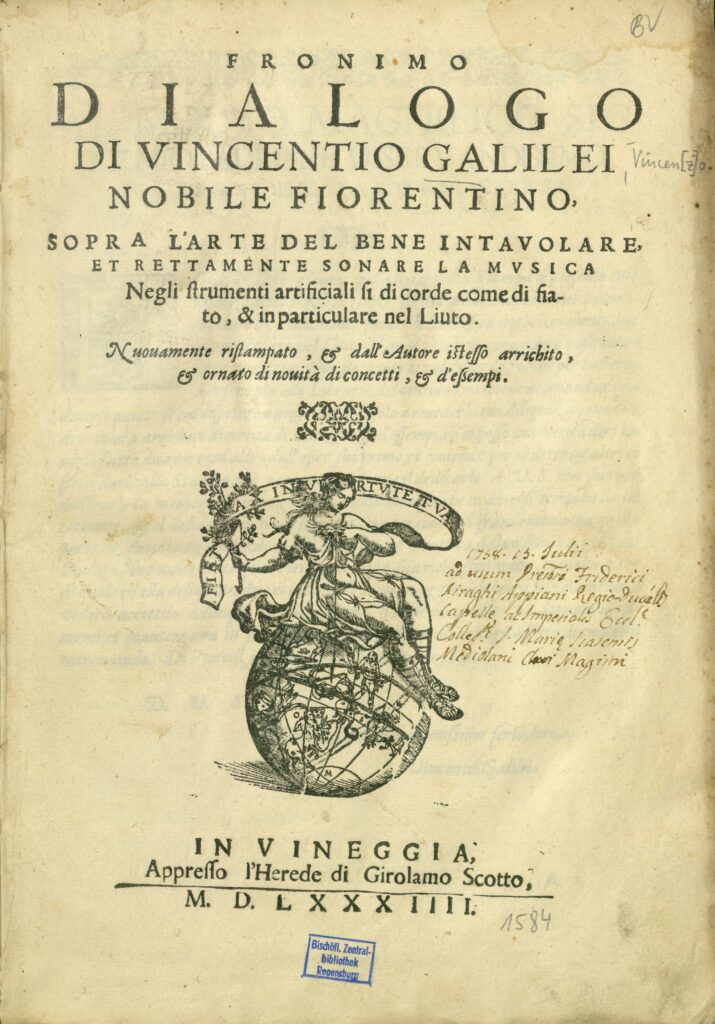
Vincenzo prefaced his second publication with the following one-page dedication to the Wittelsbach prince Wilhelm (later Duke Wilhelm V,1548-1626; reigned 1579-1597):
All’Illustriss[imo] et Eccellentiss[imo] S[ignor] Principe il S[ignor] Gvlielmo Conte Palatino del Reno et Dvca dell’vna et l’altera Bauiera, signor mio sempre osseruandiss[imo].
Il degno et raro nome (Illustriss[imo] et Eccelentiss[imo] S[ignor] Principe) che l’Illustrissimo et Eccelentissimo signor Duca vostro padre s’ha con tanta sua lode acquistato d’honorare et essaltare generalmente tutte le virtù, et in particolar la Musica, ha reso chiara testimonianza della nobilità et generosità dell’animo di tanti famosi dell’Illustriss[ima] et Serenissima casa di Bauiera; et la mente sua esser eleuata alle alte et supreme cose, quanto la Musica è conforme all’armonia celeste; cagione certissimamente, che molti gentili spiriti, suegliati da si dolce suono, si sono ardentissimamente a quelle applicati, et con tanta maggior affettione e studio, quanto hanno visto V. S. Illustrissima non meno pronta e liberale d’un tanto padre in fauorirli et remunerarli. Although I am of the same mind, and in spite of the example of many and many others, who, since they are part of the audience, are aware of the continuation of the corralling of the virtuosic fatalities, I must write the present dialogue, according to FRONIMO, of the method of introducing music into the song; et hor volendolo mandar in luce, hò deliberatò consecrarlo al suo glorioso nome; accioche tutta via succedendoli per heredità l`Oceano delle virtù, habbia dal mio picciolo ruscello la parte delle feudatarie acque. Accettilo adunque come tributo à lei douuto con l’innata sua singolar benignità, si come con prontissimo animo glielo dono et sacro. Et non mi essendo concesso al presente, secondo il mio buon desiderio, farle riuerenza personalmente, con quella vera humilità, che ad un fedelissimo et obedientissimo seruitor si richiede, et un tanto Principe merita, glielo faccio di lontano con sincerissimo animo.
Di Venetia il di 20. Ottobre 1568.
Di V[estra] Illustriss[ima] et Eccellentiss[ima] signoria
Humiliss[imo] et devotiss[imo] servitor
Vincentio Galilei.
In his detailed dedication, Vincenzo Galilei eloquently and skilfully praised the stalwart and sophisticated cultivation of culture and art at the territorial court in Munich under the patronage of Duke Albrecht V (1528-1579, reigned 1550-1579)8 in a particularly bright testimony to the noble and magnanimous spirit of the widely famous House of Bavaria; through its endeavors to support the cultivation of music, it touched contemporary cultural life at the very core. The phrase armonia celeste refers to the central theme of “harmonia mundi” or “harmonia universale”. The unusual commitment was passed on from father to son, so that the dedication of the book to the latter is fully justified.
The dedication was an unusual step. Until then, Vincenzo had no connections with the House of Wittelsbach or the Duchy of Bavaria. Tensions over questions of rank and ceremonial precedence dating back to the time of the Council of Basel (1431-1449) characterised sporadic political relations between the two distant territories. Contacts were few and not free from mutual mistrust.9 Over the course of the following century, only very isolated, cautious and reserved contacts occurred at the subordinate diplomatic level. On the occasion of the marriage of the Medici Prince Francesco I (1541-1587) to the Habsburg Princess Joan (1548-1578) on 18 December 1565, Munich initially sent deliberately subordinate representation to Florence in the person of the Duke’s brother Ferdinand (1550-1608). This prompted the Medici to participate only reservedly with a small delegation in the subsequent Munich wedding festivities of 1568. Why did Vincenzo nevertheless decide to offer up this unusual dedication from such a remarkable spatial and unmistakable mental distance?
The answer is clearly found on the side of Duke Albrecht V of Bavaria. He was the first sovereign to rule the reunited duchy in its entirety; only now did Munich begin to rise as its capital city. As a great patron of culture, he wanted to develop the city into a glamorous residence. However, only after suppressing the threat of an aristocratic uprising in 1563/64, could he bring these endeavours to fruition. He began to transform his territory into an important cultural state. As a generous sponsor, he promoted art, science and culture with unusual dedication. In doing so, he pursued two objectives: Internally, he wanted to emphasise his pre-eminence as a glorious Renaissance prince of Italian stature. Externally, he sought to lead the Catholic party in the Holy Roman Empire of the German Nation at a time when the Habsburg dynasty was weak. The most visible sign of this reorientation was the magnificent celebration of the wedding of his son, Prince William, to Renata of Lorraine (1544-1602) in February/March 1568. The first major court celebration in the Munich Residence, it attracted the attention of the whole of Europe.10
These circumstances explain the dedication in Vincenzo’s ‘Fronimo’. The renowned musician intended to partake in the festivities from afar and capitalise on them. He undoubtedly set his sights on a position at the art-loving court of Albrecht V, considered the leading in Europe.11 There were no personal connections. Three like-minded people encouraged the respected lutist in this endeavour. Orlando di Lasso (1532-1594) had been the key cultural organiser at the Munich court for more than a decade.12 Familiar with the musical world in Italy, he worked there for many years. He already contributed to Vincenzo’s first works in 1563 and 1568/69;13 he also published with Scotto. He was joined by the Neapolitan Massimo Troiano († after 1570), who actively participated in the Munich wedding celebrations and, after their conclusion, sought to promote continued employment at the Wittelsbach court from Venice alongside his private business.14 The third, the Florentine Alessandro Striggio the Elder (1536/37-1592), made significant contributions to Munich’s musical life in 1567 and 1568 by performing several compositions there.15 His spectacular “Missa sopra Ecco sì beato giorno”, also performed in the Munich Neuveste, featured 40 and 60 voices and attracted much particular attention. Although he was unable to take part in the festivities himself, two of his compositions were included in the programme. He also personally engaged in its publication in Venice.
Thus, the activities of three key players in contemporary musical life, who had all played a significant role in the Munich wedding celebrations, came together in the cultural capital of Venice. Together they encouraged Vincenzo Galilei, not involved in the celebrations, to dedicate his new book currently in production to Munich’s heir apparent, Prince Wilhelm, and to promote an appointment at court.
The plan did not work out. The publication with a dedication dated 20 October 1568 did not appear until 1569. By then, the Munich celebrations were long over. There is no indication that the Wittelsbach court even took note of the new publication and its dedication. A very rare book, it cannot be traced in the Munich court library (Fig. 1).16 Vincenzo’s attempt to contact di lontano went completely unnoticed. One thing is decisive: the attempts at establishing contact originated with Vincenzo. The Italian sought to exploit uniquely favourable conditions at the court of Albrecht V for himself and therefore took the first step.
Recruitment by Duke Albrecht V.
Despite the failure, efforts to establish a connection did not come to a standstill. However, the initiative subsequently passed to the other side. Precisely through the festivities of 1568, Duke Albrecht V distinctly experienced the effectiveness of his cultural policies and decided to continue with them. Generously, he made further funding available to bring artists from Italy into his service.17 He commissioned Orlando di Lasso to undertake three journeys to Italy in the seventies (1573, 1574, 1578) to advertise locally.18 One after the other, he personally visited major cultural centres and engaged Italian musicians, actors, comedians, artists, jugglers and entertainers. An extraordinary number of Italian cultural personnel came to Munich as a result. His activities as an artistic agent can be traced to Florence, where he had already established relations with controversial Archbishop Antonio Altoviti (1521-1573, Archbishop from 1548) in the 1550s. Without doubt, the offer to Vincenzo Galilei arose in this context. Orlando, more than anyone else, ensured his recruitment through his continuation of earlier initiatives of 1563 and 1568.
At that time, for example, the Florentine lutenist Cosimo Bottegari (1554-1620) was recruited for the Wittelsbach court. In the summer of 1573, he came to Munich for several years and was received with honour. On 11 September of that same year, the Duke promoted him to the rank of chamberlain. In 1577, he was even knighted.19 During his time in Munich, he composed his main work “Il libro di canto e liuto” (1574).20 However, Bottegari soon became embroiled in a bitter dispute with his former patron Orlando. The affair is described in his confidential letters to Prince Wilhelm, though the background and details remain unclear.21 Under the circumstances, the musician soon turned his back on Bavaria and returned to the Medici circle in Italy after a few years.
Another musician appointed by Orlando to the Munich court at that time was Gioseffo Guami (1542-1611), who came as organist to the court chapel from Venice. After a brief stint in 1568, he returned to Munich for several years from 1574.22 Other instrumentalists of Italian origin who were engaged are found in Rainer’s recent and instructive catalogue of staff in the court choir, documenting a visible increase from 1572.23
In Vincenzo’s case, however, recruitment efforts remained unsuccessful. The main reason was that his personal situation changed fundamentally for the better in the 1570s. Since 1572, he consolidated his position in Florence, generously patronised by local magnates. He found a musical home in an association of art and music lovers known locally as the “Camerata Fiorentina”, where he engaged as a theorist and established a profile as one of its spokespersons. He gained recognition and prestige, making a name for himself. His ties to Florence thereby solidified. His increasing age and growing family had a similar effect; under the circumstances, the city on the Arno assumed central importance in his life. Vincenzo had created a personal and artistic environment which he was no longer prepared to give up. Relocation would only have jeopardised the security he had fought so hard to achieve.
However, let us consider the Duke’s position, which had undergone a volte face. The estates in Bavaria increasingly criticised Albrecht’s excessive penchant for patronage. At every Diet from 1557 onwards, they reproached the Duke for unbridled spending on residence buildings, court festivals, musical events and cultural events. They particularly resented the outflow of monies abroad. Some undesirables also numbered among those receiving support.24 They quite literally affected a negative stance against such ‘new comers’.25 At first, the Duke shrugged off the criticism. However, he too eventually recognised the critiques as justified within the limits of a responsible fiscal policy.
Foremost, the Giovanni Ciurletta affair provided a just cause.26 In 1571, Duke Albrecht V called the native of Trient to his court as an expert in matters Italian, and entrusting him with a fiduciary appointment as chamberlain. This left him in charge of the delicate negotiations of a financial loan from the Grand Duchy of Florence, intended to alleviate his financial difficulties and thereby weaken the position of the estates. Ciurletta did indeed obtain a promise from the Grand Duke. However, he suddenly disappeared with a considerable sum of the loan and went into hiding. The Court accused him of embezzling several thousand scudi. The Ciurletta affair led the Duke, already deeply annoyed to the extent that he ordered a manhunt for the negotiator, to alter his decision about recruiting artists from Italy. He adopted a distanced stance from 1575 onwards. When financial difficulties simultaneously came to a boil, his previous relationship of trust with Orlando cooled considerably.
Vincenzo naturally also had to take this change of mood into consideration. Internal Bavaria affairs seemed to offer little favourable possibility to accept Orlando’s offer. He would have had to give up an excellent situation in Florence to move to an unsure foreign circumstance. As a level-headed artist and responsible family man, he was no longer prepared to do so. He changed his attitude towards the court in Munich court and reached a decision dictated by common sense. He now declined the offers he had previously sought. Despite initiatives from both sides, therefore, the two parties would not reach an agreement for many years due to the changing circumstances.
The journey to Munich in 1578
After a decade of discussion, the project could only be realised in 1578. Vincenzo Galilei finally set off on the long-anticipated journey to Munich. Admittedly, events took a completely different turn than anticipated. Taking into account the biographical accounts of all concerned, the journey can likely be dated to the summer/early autumn of 1578. According to the information in the dedication (consegnatoli l’Ottobre), the manuscript of the volume printed in 1581 with the two references had been completed in autumn of the previous year; i.e. due anni sono che io fui à quella corte refers to this very year. The birth of their daughter Livia on 7 October 1578 marked a milestone in the life of the Galilei family, soon followed by another joyful event, the birth of their daughter Lena in 1580. As the winter months precluded travel, the journey to Munich most likely took place in the months before Livia’s birth. In June of that year, Orlando’s presence is verified by legal documents noting a property deal in the Munich area of Maisach (in the county of Fürstenfeldbruck). Other facts favour the suggested timing of the journey as well.
The journey was certainly of short duration. Vincenzo was neither active in Munich as a practising or composing musician, nor did he take on any teaching duties, as had been his initial intent. Neither did he enter into a direct relationship with the Duke at court as previously envisaged. Indeed Vincenzo journeyed to Munich almost as a tourist on a targeted sightseeing programme. His main interests included unusual musical instruments and instrument making. And in this regard, the northern foothills of the Alps, and Munich in particular, had much to offer.
Firstly, the diocesan musicians at the Church of our Lady in Munich had a unique collection of small organs, which Vincenzo inspected. In retrospect, a short note in the third book of his “Dialogo della musica antica e della musica moderna” enthusiastically reports: l’Organo. fu in vso questo strumento primamente nella Grecia, et d’iui per l’Vngheria si trasferì nella Germania tra i Bauari; et ciò dico per auerne veduto vno tra li altri nella Chiesa Cattedrale di Monaco, Città principalissima di quella prouincia, con canne di bossolo tutte d’vn prezzo, grande e tonde all’ordinario delle nostre fatte di metallo; il quale nel suo genere et di quella grandezza è il più antico d’alcun’altro che si troui non solo in tutta Germania, ma forse in qual si voglia altra parte del mondo, et perciò tenuto in ueneratione da quei populi.27
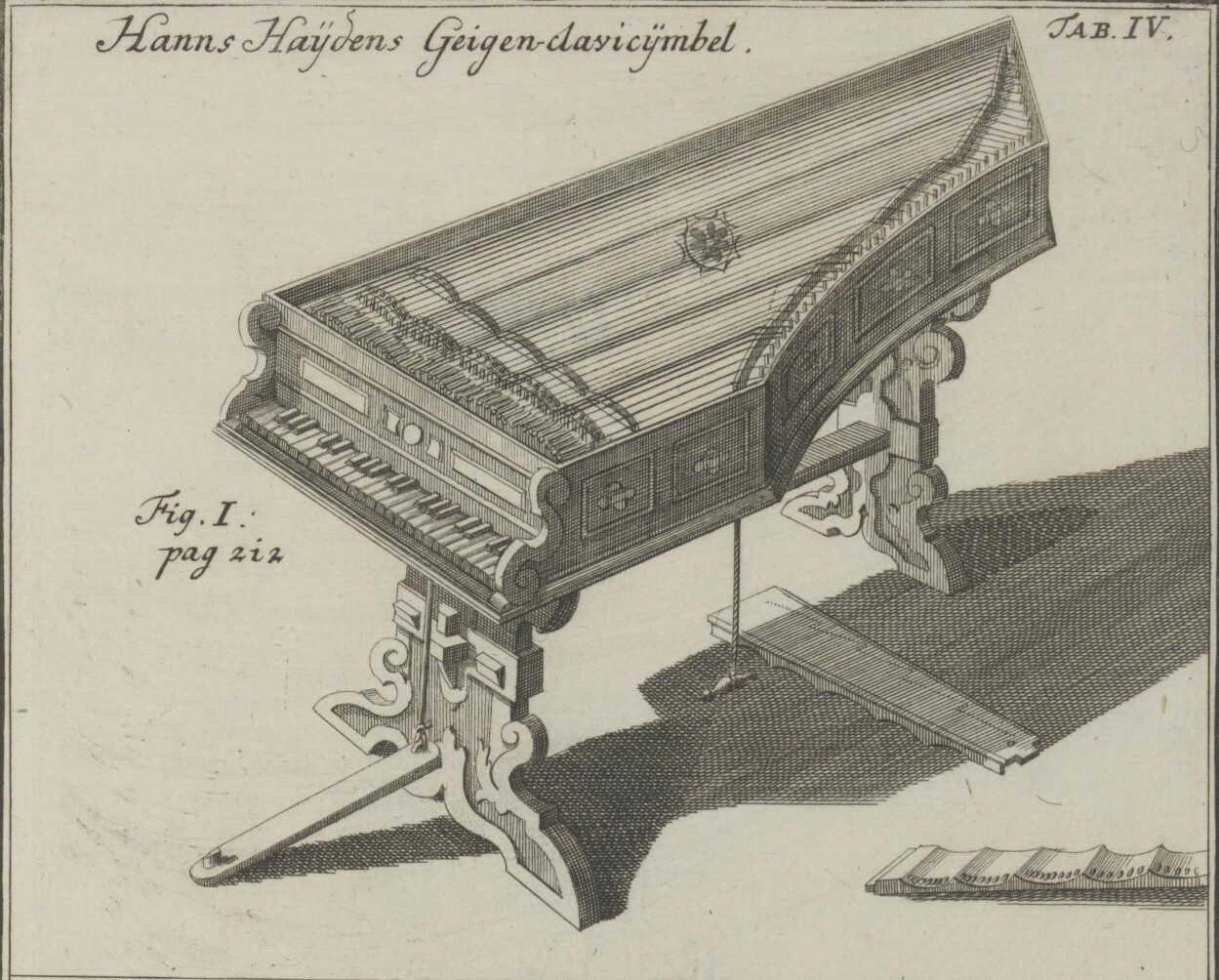
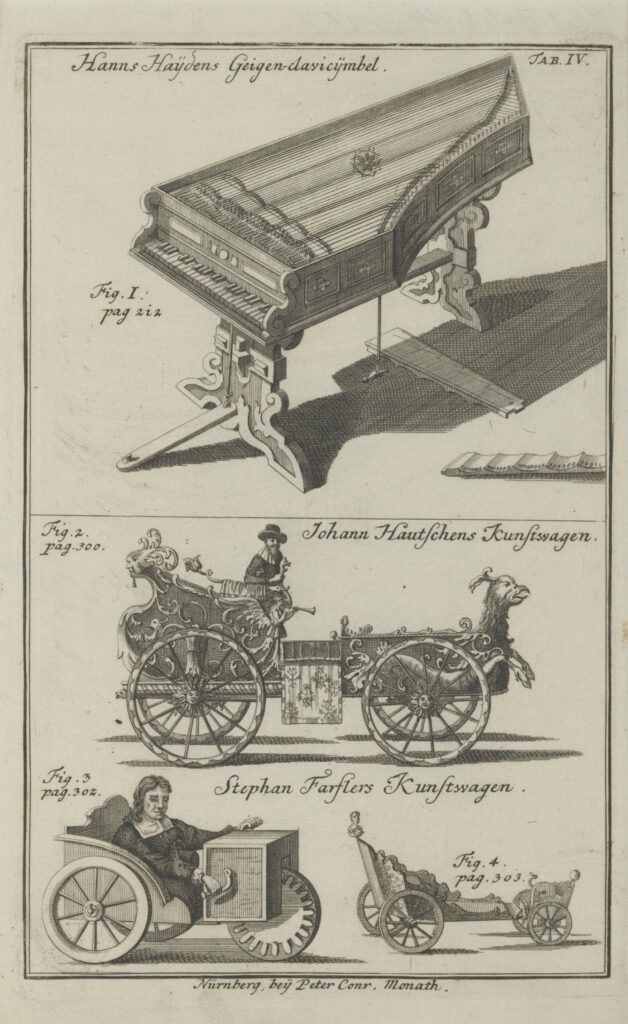
Futhermore, Vincenzo Galilei gained knowledge of a completely new, spectacular musical instrument at court, which combined the possibilities of keyboard and string music in an extraordinary way. The so-called ‘Nuremberg violin clavicymbel’ (“Nürnbergische Geigen-Clavicymbel”), a work of the famous Nuremberg instrument maker Hans Haiden (1536-1613) and, in expert opinion, considered the most remarkable new development on the music scene and attracted widespread attention (Fig. 2). It first came to Munich as a gift from the Elector Augustus of Saxony (1526-1586, reigned 1553-1586), received during a visit by the Wittelsbach court to Dresden in June 1576.28 Only Orlando could have told Vincenzo about it, thereby arousing the latter’s intense curiosity. In fact, it was probably this discovery which prompted him to head north, since Orlando also obtained travel permission for him at that time. This unusual instrument drew him above all else and he wanted to see and test it.29 And indeed, the guest obtained permission to play it. His expectations of the journey were thus crowned with success. This event is actually described in detail in the same publication with the following words: Strumento di tasti molto artifitioso et bello. After two years, the author still remembered Vn’altro essempio d’vno Strumento di tasti, che già l’Elettore Augusto Duca di Sassonia donò alla felice memoria del Grande Alberto di Bauiera, mi souuiene in questo proposito, piu di ciascuno altro efficace. il quale Strumento ha le corde secondo l`vso di quelle del Liuto, et vengano secate à guisa di quelle della Viola da vn’accomodata matassa artifitiosamente fatta delle medesime setole di che si fanno le corde à gli archi delle Viole: la qual matassa con assai facilità, viene menata in giro con vn piede da quello istesso che lo suona, et ne seca continuamente col mezzo d’vna ruota sopra la quale passa, quella quantità che vogliano le dita di lui. il quale Strumento, due anni sono che io fui à quella corte, temperai secondo l’vso del Liuto, e faceua di poi ben sonato, non altramente che vn corpo di Viole, dolcissimo vdire.30
According to the account, the short stay in Munich actually brought the visitor from Florence in close proximity to the court. However, neither the duke nor the state administration took any notice of the guest. The visit was in no way an official and ultimately a private one. The trip was initiated, arranged, organised and supervised by Orlando. It had little to do with the court. One might even say that the visit was mainly instigated by a gift from the Elector of Saxony. Above all, it served to satisfy his artistic curiosity by allowing him an opportunity to play and examine the instrument and to inquire about its construction. That exceptional artist hoped to learn first-hand about the foothills of the Alps as an important production center, as well as the artistic riches of Munich.31 It was for this reason that he decided to make his only journey north of the Alps at an advanced age. His curiosity was later reinterpreted as instrumental espionage, but there is no credible evidence for this.32 This ulterior motive, subsequently foisted upon him during the agitated mood in the early weeks of the Thirty Years’ War in Germany, was typical of a time when confessional and national emotions fostered such suspicions.
Therefore, it should come as no surprise that he never met Duke Albrecht V, so idolised in the dedication of 1568. After all, the Wittelsbach Duke struggled with a severe stomach and kidney ailment since 1575 and frequently sought relief in travel to therapeutic baths.33 However, the treatments did not bring the desired cure. Disappointment led the Duke to regret his cultural endeavours. In his will of 1578, he distanced himself from his previous ostentation and love of display. Instead, he now advocated the pious values of modesty, simplicity, renunciation and asceticism.34 In the final months of his life, Albrecht V altered both his lifestyle and his cultural policies. Under those changed circumstances, the idea of a personal meeting with the Duke or artistic engagement at court were no longer viable options. Therefore, the short duration of Vincenzo’s visit had little to do with Albrecht V’s death. The Duke died on 24 October 1579 due to his longstanding illness. His death prompted Vincenzo’s compatriots Bottegari and Guami to return to their Italian homeland and take up new positions there. They feared that working conditions would deteriorate considerably under Albrecht’s successor.
Thus, there was never any personal contact between Duke Albrecht V and Vincenzo Galilei. Nevertheless, there is undoubtedly a logical connection between the dedication of the “Fronimo dialogo” of 1568 and the journey of 1578.35 During that decade, a visit to explore the musical aspects of Munich represented a real aspiration for Vincenzo, one he briefly achieved after many years of hesitation and waiting. Many circumstances compromised the realisation of that journey, envisaged for a decade but postponed for some time and was only realised in truncated form.
Most of the events described above are essentially based on a single source. It has been cited here from the two tangential comments taken from Vincenzo Galileo’s primary work “Dialogo della musica antica et della moderna” (1581).36 The description of notable musical instruments explicitly refers to the visit to Munich. In the first instance, it describes the noteworthy keyboard instrument, with reference made to the highly regarded “Nürnbergische Geigen-Clavicymbel” by Georg Haiden, which came to the Wittelsbach court as a gift from Elector Augustus of Saxony: … due anni sono che io fui a quella corte.37 In that regard, reference is also made to the remarkable collection of organs at the Liebfrauenkirche in Munich, which was visited on the same occasion and held up for scrutiny: … et ciò dico per auerne veduto.38 In other words, any suggestion of Vincenzo’s personal stay in Munich is based upon a nearly contemporaneous ego document, with very high source value.
However, it must be emphasised that one serious difficulty stands in the way of this interpretation. The documentary transmission of the second passage cited here attributes the decisive statements not to Vincenzo, but in fact to Giovanni de’Bardi (1534-1612), the shining star of the “Camerata Fiorentina” and Vincenzo’s influential mentor.39 No independent corroboration has yet been discovered in the otherwise rich and informative Bavarian source materials. What does this individual discovery actually mean? How can the problem of source criticism be solved? This requires some discussion, since the passages cited are actually interpreted differently. It is unclear whether it was really Vincenzo who travelled to Munich, as stated in the interpretation presented, or whether it was the Conte de’Bardi, as referred to in the “Dialogo”.
In order to clarify the question, we must first consider the source genre. The literary formula of the “Dialogo”, popular at the time, derives from the seminal “Phaidros” by Greek philosopher Plato (428/27-348/47 BC). Researchers agree that this major work by the Athenian philosopher, like his other dialogues, is not meant as a truthful reproduction of conversation, but rather takes the form of an argument between two or more discussants.40 In doing so, the author takes generous poetic license. Therefore, the statements cannot be taken at face value; a literary fictionality needs always be taken into account. The author is not the speaker himself but rather puts his own words into the mouths of others. He communicates only indirectly with the reader. The author hides behind a perhaps newly imagined character in the foreground and transfers his ideas on to this character. In this way, the reality of the actual events become secondary. The only question remaining is: To what extent?41 The answer can only be: “Historical reality and the resultant artistic creation are … indistinguishable.”42 The author is not present in the text; researchers characterise the result as “Platonic anonymity”. In these distinct roles, the spokesperson reports and represents the views of the author. It is up to one or more partners to the dialogue to offer up and discuss the conceivable objections, increasing the breadth and depth of argumentation. The task of justifying ideas presented falls to the insertion of ‘considerations’ (“considerationes”), strengthening the intellectual foundation of the proposition. In short, these are “staged conversations” whose poetics need not to be considered in any evaluation.43 Statements must be interrogated within their role-bound nature and perspective: The “Dialogo” does not offer historiography, but poetry. Plato’s authority continued to influence the poetry of the genre during the early modern period in a most enduring fashion.
Like other contemporaries, the late humanist Vincenzo Galilei also engaged with this poetic model, adopted from antiquity and redefined in Renaissance literature. In keeping with this genre theory, he hid behind the dialogue. He assigned the role of spokesman to the esteemed Giovanni de’Bardi, whose trustworthiness and authoritative competence are explicitly and unmistakably placed at centre stage from the start. The entire “Dialogo” is dedicated to him: All’Illustrissimo Signore, et mio padrone osservandissimo, il Signor Giovanni Bardi de’Conti di Vernio.44 In the poetic reworking of real events, the noble Conte takes on the role of spokesperson, allowing the author to express his views through him. In this manner, the Conte Bardi stands for Vincenzo; Bardi is Vincenzo’s mouthpiece. Against this backdrop, the knowledgeable interpreter correctly identifies the Conte as a “reliable pilot”, through whose mouth Vincenzo expresses his own lofty thoughts in skilful literary form.45 A rebuttal offered by his discursive opponent, Piero Strozzi, serves to grant the discussion greater depth and room for further exploration. Therefore, the statements of the “Dialogo” are not intended as factual descriptions of the interlocutores, but instead should be interpreted in consideration of the poetic alienation. In accord with genre theory, we need to evaluate the dialogue from a literary point of view. In this interpretation, the two references to the visit to Munich attributed to Bardi can certainly be interpreted as a self-referential statement by Vincenzo.
The statements attributed to the Florentine cultural magnate Giovanni de’Bardi actually make little sense, since he had no verifiable connection to the Bavarian ducal court. Any Florentine delegation which might have visited the court in the case of such a journey by Bardi, would surely have been mentioned in the sources; however, there is no such mention.46 For that reason, the contacts attributed to Bardi in the “Dialogo” should be interpreted as literary coding in reference to the literary genre of Plato. Here, everything indicates that the author Vincenzo expresses his own personal experiences, skilfully manipulating the narrator’s roles; in this interpretation, Vincenzo surely made the journey himself.
A knowledgeable contemporary, Michael Praetorius (1571-1621), already understood these two references from the “Dialogo” in exactly this sense;47 they are interpreted this way consistently up to the present day.48 An authoritative handbook, for example, formulates with appropriate caution that: “Between 1578 and 1579, Galileo visited the court of Albrecht V, Duke of Bavaria.”49 The “Bayerische Musiker-Lexikon Online” also includes Munich among the list of places where Vincenzo was active.50 However, the latter suggestion is not entirely true; the short stay was unproductive and never intended to be. Nonetheless, it represents a meaningful conclusion to the intentions and endeavours of the preceding decade. This interpretation, based on a literary analysis of the few available references conforms with the sequence of events in Vincenzo’s biography. By interpreting the passages in question as a factual report is to make speculative assumptions for which no evidence can be provided.
The literary interlocutor Conte de’Bardi functions to allow the author to make first-person formulations emphasising and substantiating his own testimony about his personal encounters with art. He calls upon his own personal endeavours and relevant experiences. Through these two bits of evidence, he provides empirical support for discussions otherwise based on philology and logic: personal observation is intended to reinforce his arguments. This extension of the argumentative strategy provides an additional element for Vincenzo’s characteristic return to the realities of empirical knowledge.
The aftermath
Upon his return from Munich, Vincenzo Galilei entered into the fruitful last decade of his life in Florence. With the generous support of local patrons, he produced major works in rapid succession. They pioneered new directions in musical discourse introducing the “stile nuovo” of monody and novel combinations of musical art and knowledge. Significantly, we can see that in a new edition of the “Fronimo dialogo” from 1584, the earlier dedication to the Wittelsbach heir apparent Wilhelm, now the reigning duke, was replaced by a dedication to the Florentine entrepreneur and composer Jacopo Corsi (1561-1602).51 The ageing Vincenzo had completely lost sight of Munich, his focus for a decade. His gaze completely shifted to Florence. This remained so until his death on 2 July 1591.
Nevertheless, contacts initiated by Vincenzo with the Bavarian ducal court continued at a discreet level. Somewhat less conspicuously, Stefano Rossetto (also Rossetti) († 1584) continued cultural relations.52 That musician, briefly succeeded Gioseffo Guami as court organist in Munich in 1580, though he is primarily documented in Florence. Although there is no evidence for a direct connection with Vincenzo’s journey, it can certainly be surmised. The synchronicity of his stay is hardly coincidental. His work in Munich is convincingly documented by a witness to his mass “Consolamini popule meus”.53 However, his stay was brief. He and several other instrumentalists resigned from their posts in Munich when prospects deteriorated following the Duke’s death . However, court connections continued to have an effect. They re-surfaced during the brief visit of the Archbishop of Florence, Cardinal Alessandro Ottaviano de’ Medici (1535-1605), to Munich in mid-September, 1604: ist ihme grosse Ehr erzaigt worden.54 Francesco Maria Cardinal del Monte (1549-1627), a high-ranking church prince and clerical diplomat with close ties to Florence and the Medici family and a notable supporter of Galileo Galilei, also engaged with the Wittelsbach court circle.55
The relations between Florence and Munich, intensified by Vincenzo Galilei, witnessed a revival, indeed a first real blossoming, one-and-a half decades after his death and now reached their first heyday. Galileo began a search for a position for his brother Michelangelo (1575-1631). He recalled the earlier associations in Munich,56 and endeavoured to revive them. In 1607, having achieved the status of a European scholar, he secured the appointment of his brother Michelangelo as an instrumentalist in the ducal court chapel.57 For the rest of his life, he played the lute at the Munich Residence, helping to elevate it to European standing. He dedicated his only composition to the sovereign, a fundamental piece of early lute art acknowledged throughout Europe.58 Munich became the unexpected life-long residence for his large family, blessed as they were with many children. In this manner, the prolific side-branch of the great natural scientist Galileo Galilei came to reside in the electoral Bavarian residence and capital city. Michelangelo’s son, Albrecht Caesar (1615-1692), inherited his position as lutenist and held it for more than half a century after his father’s death in 1631.59 He established a respectable family home in the traditional complex in Fürstenfeldergasse no. 15.60 The relationship can be traced back over three generations and only ended with the death of Vincenzo’s great-grandson Franz Nestor (1640-1694).61 With the death of Franz, a deaf-mute said to have worked as a local painter, the family line came to an end after a very eventful run. Vincenzo’s initiative was thus followed by more than a century of turbulent times, characterised above all by the horrors of the Thirty Years’ War. Indeed, the cultivation of the high art of the lute in Munich is inextricably linked to the name of the Galilei family. In this field, they earned lasting merits in Bavaria. Their importance – following the example of Vincenzo and in contrast to the natural scientist Galileo – lies exclusively in the field of music. The little-noted status of the Galilei family as one of the most renowned European families of musicians is therefore also inextricably linked to Munich in that later phase.
The latest research on Galileo interprets the close personal and artistically fruitful relationship between father Vincenzo and son Galileo as a unique interaction between music and science.62 In this regard, the Munich line also made a remarkable contribution. The lutenist Michelangelo Galilei played a pioneering role in bringing the world-changing research of the natural scientist Galileo to the northern Alpine region as the mediator of the decisive tool, Galileo’s telescope, so coveted in Europe since the publication of the book “Sidereus nuncius” (Venice 1610).63 Vincenzo can therefore be described as a pioneer and Michelangelo as the founder of the Munich Galilei line. Overall, a remarkable lineage of tradition emerges.
Today, these Munich Galilei are commemorated by a very inconspicuous memorial plaque on the southern outer-wall of the Church of Our Lady.64 Eleven members of the Galilei family of artists were buried in the prominent cemetery there. The weathered epitaph is the only monument to remind us of the Munich line. Otherwise, it left no visible trace. For that reason, its members have receded from public awareness in Bavaria.
Munich is well-aware of the protagonist Galileo Galilei, although he never crossed the Alps himself; nevertheless, the city dedicated a square to him in 1906 as well as a memorial sculpted by Matthias Rodach in 2009. The memorial in the astronomy quarter of Bogenhausen, as well as several research institutions bearing his name in and around Munich, solely honours the pioneering scientific achievements of the universal genius. As such, it is relatively recent, not dating beyond the beginning of the 20th century and in connection with the founding of the Deutsches Museum in 1903. There is no connection with the Munich Galilei family of artists. After their demise, they were completely forgotten by the city government as well as the culturally interested citizenry. That has not changed to the present.65 Even endeavours to proclaim Munich with the attribute “Isarflorenz” ignored this possible – and worthwhile – possibility. The secondary strand of the family of the universal genius represents a novel link between Italy and Bavaria, adding a highlight to the already shining string of transalpine relations. The Galilei family too made a pioneering contribution to the broad cultural transfer from Italy to the northern foothills of the Alps in the age of humanism and the Baroque. It remains a worthwhile task to return the Munich Galilei family into public memory. This applies equally to Bavaria and Italy.